
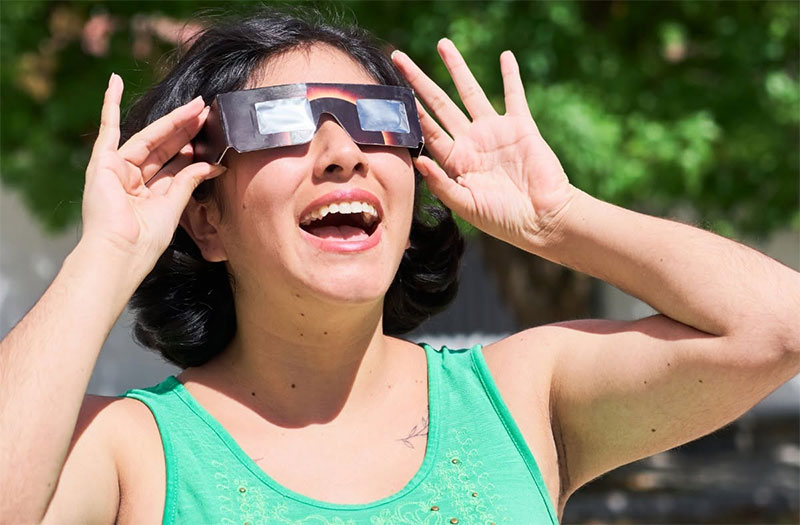
The Eclipse 2026 solar eclipse was a remarkable astronomical event, but watching the Sun safely was just as important as finding a good viewing location.
On 12 August 2026, the UK experienced a deep partial solar eclipse. In many parts of Britain, around 90% or more of the Sun was covered by the Moon. However, because the UK experienced a partial eclipse rather than totality, there was no stage during the event when it was safe to look directly at the Sun without proper solar protection.
This guide explains how to watch Eclipse 2026 safely, which types of eye protection are suitable, what equipment should never be used without a solar filter, and how to enjoy future solar eclipses without putting your eyesight at risk.
Why Is Solar Eclipse Safety Important?
The Sun produces extremely intense visible and invisible radiation. Looking directly at it can damage the retina, the light-sensitive tissue at the back of the eye.
The danger can be especially deceptive during an eclipse because the Sun may appear much dimmer than usual.
Even when most of the Sun is covered, the remaining bright portion can still cause serious eye injury. NASA specifically advises that during a partial solar eclipse, it is never safe to look directly at the Sun without specialised solar viewing protection.
Eye damage may not be immediately obvious, which is another reason not to take chances.
Was Eclipse 2026 Safe to Look At With the Naked Eye?
No.
Because the eclipse was partial in the UK, observers needed appropriate solar eye protection throughout the event whenever looking directly at the Sun.
This is different from a total solar eclipse viewed from inside the path of totality. During the brief period of true totality, when the Moon completely covers the Sun’s bright surface, direct viewing can be safe. That situation did not occur in the UK during Eclipse 2026.
Use Proper Eclipse Glasses
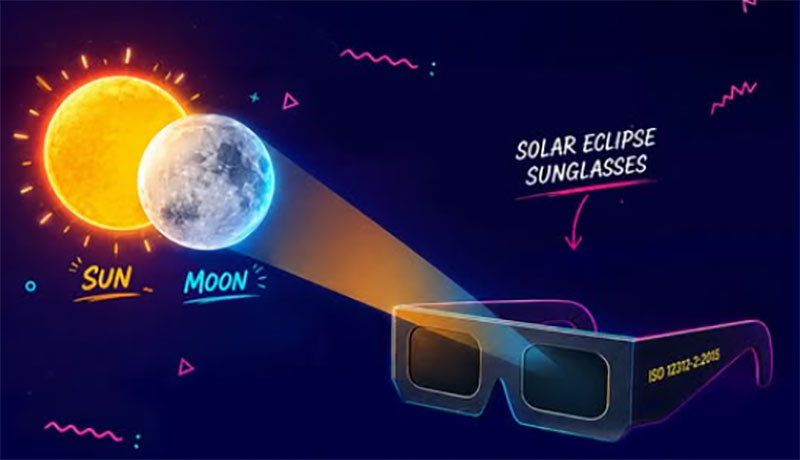
One of the simplest ways to view a partial solar eclipse directly is to use properly designed solar eclipse glasses or a safe handheld solar viewer.
These are not ordinary sunglasses. NASA says safe solar viewers should comply with the ISO 12312-2 international standard.
Before using eclipse glasses, inspect them carefully.
Do not use them if the viewing material is:
- Scratched
- Torn
- Punctured
- Creased or otherwise damaged
The Royal Observatory Greenwich also recommends checking that eclipse glasses carry the appropriate ISO 12312-2 safety certification and manufacturer information.
Are Normal Sunglasses Safe During a Solar Eclipse?
No.
This is one of the most important eclipse safety rules.
Even very dark sunglasses are not designed to provide the level of protection required for direct solar viewing. NASA and the Royal Observatory Greenwich both warn that ordinary sunglasses should not be used as a substitute for certified solar-viewing equipment.
So, never assume that several pairs of sunglasses worn together will make eclipse viewing safe.
They will not.
Can You Use a Telescope or Binoculars?
Not without the correct solar filter.
Telescopes and binoculars collect and concentrate sunlight. Looking at the Sun through unfiltered optical equipment can cause severe and permanent eye damage.
There is another important point that many first-time eclipse viewers miss:
Do not wear eclipse glasses while looking through an ordinary telescope, binocular or camera optical system.
Eclipse glasses are designed for direct viewing with the unaided eyes. Optical equipment requires a special-purpose solar filter fitted securely to the front of the optical system. NASA specifically warns that concentrated sunlight can damage or destroy an unsuitable filter and cause serious eye injury.
How to Safely Photograph a Solar Eclipse
Solar eclipse photography can produce beautiful images, but cameras also require proper protection.
A camera lens pointed directly at the Sun can concentrate intense sunlight into the camera’s optical system.
For direct solar photography, use a purpose-built solar filter designed for the camera or lens.
Do not improvise with homemade filters, exposed film, smoked glass or other materials that are not designed for solar viewing.
The safest approach is to follow the equipment manufacturer’s solar-photography guidance or seek advice from an experienced astronomer.
Pinhole Projection: A Safe Alternative
You do not need specialised glasses to enjoy a partial solar eclipse.
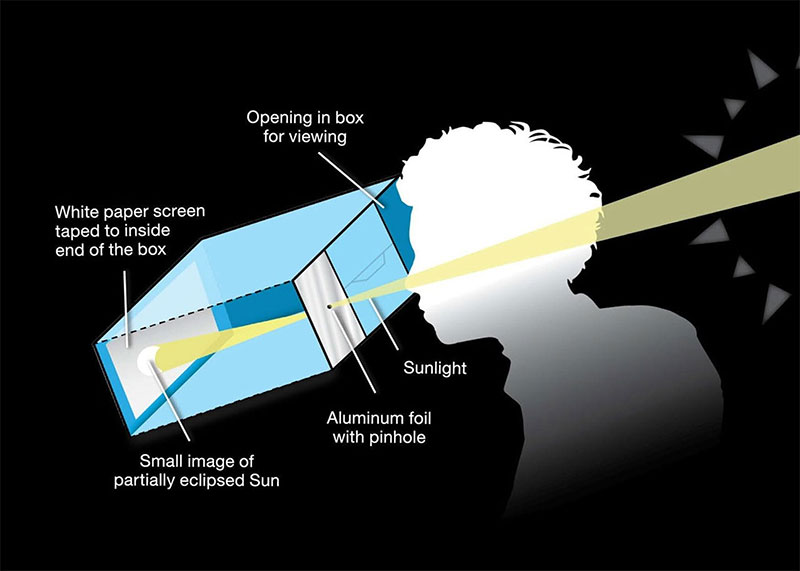
An indirect viewing method, such as a pinhole projector, allows you to observe an image of the Sun without looking directly at it.
A simple method is to make a small hole in a piece of card and allow sunlight to pass through it onto another sheet of paper. The projected image can show the changing shape of the eclipsed Sun.
The important rule is:
Look at the projected image — never look through the pinhole directly at the Sun.
NASA and the Royal Observatory Greenwich both recommend indirect projection as a safe way to observe a partial solar eclipse.
Natural pinholes can also appear between the leaves of trees. During a partial eclipse, gaps between leaves can project multiple small crescent-shaped images of the Sun onto the ground.
Keep Children Safe During an Eclipse
Children can find a solar eclipse fascinating, but they may not understand why looking at the Sun is dangerous.
Adults should supervise children whenever they are using eclipse glasses, handheld solar viewers or other solar-viewing equipment.
Check the equipment before use and make sure children understand that they must not remove their protection while looking towards the Sun. NASA specifically recommends supervising children using solar viewers.
For younger children, indirect viewing through a pinhole projector can be a useful educational alternative.
What About Cloudy Weather?
Clouds can make an eclipse difficult to see, but they do not make direct solar viewing safe.
The Sun’s harmful radiation can still pass through thin clouds.
Never assume that because the Sun looks faint through cloud, it is safe to stare at it.
Use the same solar safety precautions whether the sky is clear, hazy or partly cloudy.
Choosing a Safe Viewing Location
Eye protection is the first priority, but your physical surroundings also matter.
A good eclipse-viewing location should provide:
- A stable place to stand or sit
- An unobstructed view of the relevant part of the sky
- Enough space to use viewing equipment safely
- Protection from traffic and other hazards
- A clear horizon when the Sun is low in the sky
For the August 2026 UK eclipse, the Sun was relatively low towards the western horizon, so the Royal Observatory Greenwich recommended a high location with a clear western view.
Never Use Homemade Solar Filters
There are many questionable eclipse-viewing ideas online.
Avoid homemade filters made from:
- Tinted plastic
- Smoked glass
- CDs or DVDs
- Exposed photographic film
- Multiple layers of ordinary sunglasses
- Unverified materials sold as solar filters
A material looking dark to your eyes does not mean it blocks the dangerous wavelengths and intensity of sunlight adequately.
For direct viewing, use properly manufactured solar-viewing equipment meeting the appropriate safety standard.
What If You Have No Eclipse Glasses?
You can still enjoy a partial solar eclipse without looking directly at the Sun.
The safest alternatives include:
Pinhole Projection
Project the Sun’s image onto paper or another suitable surface.
Tree-Leaf Shadows
Watch the ground beneath a tree. Small gaps between leaves can project multiple images of the partially eclipsed Sun.
Astronomy Events
Local astronomical societies sometimes organise eclipse-viewing events using properly filtered telescopes and other professional equipment.
The Royal Observatory Greenwich recommends checking with local astronomical societies for safe solar-viewing events.
What Should You Never Do During a Solar Eclipse?
Remember these simple rules:
Never look directly at the Sun without proper solar protection.
Never use ordinary sunglasses as eclipse glasses.
Never look at the Sun through unfiltered binoculars or a telescope.
Never point an unfiltered camera directly at the Sun.
Never use damaged or questionable eclipse glasses.
Never assume clouds make direct viewing safe.
These precautions are simple, but they can prevent permanent eye damage.
Eclipse 2026 Safety: What Made the UK Event Different?
The UK experienced a deep partial eclipse rather than totality.
That distinction is particularly important from a safety perspective.
In some UK locations, more than 90% of the Sun was covered. It might therefore have looked as though only a thin crescent of sunlight remained.
But even that remaining crescent was still bright enough to cause eye injury if viewed directly without proper protection.
NASA’s guidance is clear: during a partial solar eclipse, safe solar viewing equipment must be used whenever viewing the Sun directly.
How to Prepare for the Next Solar Eclipse
The lessons from Eclipse 2026 are useful for future solar eclipses too.
Before the next event, check the date and local timing, buy or obtain appropriate solar-viewing equipment from a reliable source, inspect it before use, and plan your viewing location in advance.
Do not leave safety preparations until the day of the eclipse.
A little preparation can make the difference between an enjoyable astronomical experience and a serious eye injury.
Frequently Asked Questions About Eclipse 2026 Safety
Can you look at Eclipse 2026 without glasses?
No. Because the UK experienced a partial solar eclipse, you needed proper solar eye protection whenever looking directly at the Sun.
Are normal sunglasses safe for Eclipse 2026?
No. Ordinary sunglasses, even very dark ones, are not safe for direct solar viewing.
What eclipse glasses are safe?
Use purpose-built solar eclipse glasses or handheld solar viewers that comply with ISO 12312-2 and are in good condition.
Can I use binoculars with eclipse glasses?
No. Eclipse glasses should not be used to look through binoculars, telescopes or cameras. Those optical systems require specially designed solar filters fitted appropriately to the equipment.
Is a pinhole projector safe?
Yes, when used correctly. It projects an image of the Sun onto another surface, so you are not looking directly at the Sun. Never look through the pinhole towards the Sun.
Can children watch a solar eclipse?
Yes, but children should be supervised closely and use appropriate solar viewing equipment correctly.
Can I photograph a solar eclipse?
Yes, but direct solar photography requires a suitable solar filter designed for the camera equipment. Never use an unfiltered camera or optical system to view the Sun.
How to Watch Eclipse 2026 Safely is ultimately about one simple principle: protect your eyes first.
The 12 August 2026 eclipse was a spectacular partial solar eclipse for people across the UK, but the fact that most of the Sun was hidden did not make direct viewing safe.
Certified solar eclipse glasses, properly filtered astronomical equipment and indirect viewing methods such as pinhole projection provided safe ways to enjoy the event.
The same rules apply to future partial and annular solar eclipses. Never rely on ordinary sunglasses or improvised filters, and always use equipment specifically designed for safe solar observation.
A solar eclipse is an extraordinary natural event. With the right preparation, you can enjoy it safely while protecting one of your most important senses.
Eclipse 2026 UK: Date, Time, Map, Visibility & What Happened
More Eclipse & Astronomy Guides
- Eclipse 2026 UK: Everything You Need to Know
- Eclipse 2026 UK Time: Exact Timings by Location
- Eclipse 2026 London: Where and When to Watch
- Eclipse 2026 Map: UK Visibility Guide
- Solar Eclipse 2026: What Will You See?
- How to Watch Eclipse 2026 Safely: Eye Protection Guide
- Eclipse 2026 Weather: What UK Viewers Should Know
- Best Places to Watch Eclipse 2026 in the UK
- Eclipse 2026 Photography Guide: How to Photograph a Solar Eclipse
- What Is the Next Solar Eclipse After 2026? UK Dates & Times
Suggested
- Royal Observatory Greenwich
- Timeanddate Eclipse Information
- https://www.nasa.gov/
- European solar eclipses
- 2026 Total Solar Eclipse
writer – jurskia vorony