
Solar eclipse 2026 visibility across Britain
The Eclipse 2026 Map provides a useful way to understand how the 12 August 2026 solar eclipse appeared across the United Kingdom.
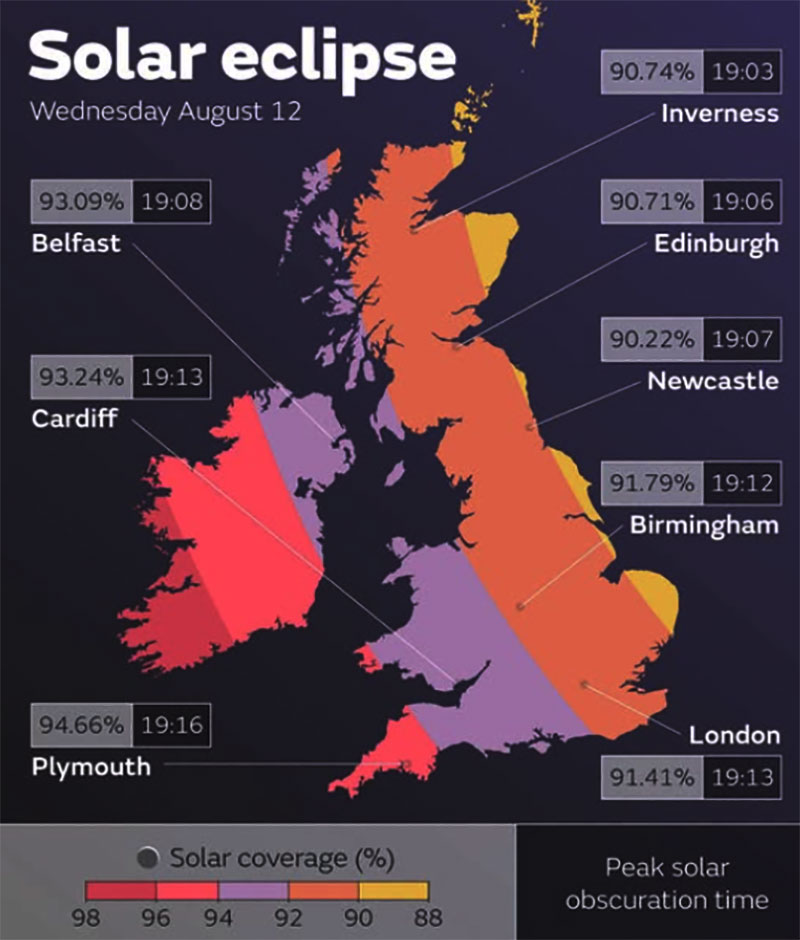
On Wednesday, 12 August 2026, the UK experienced a deep partial solar eclipse. The eclipse was not total anywhere in Britain, but a very large portion of the Sun was covered. Across the UK, the amount of solar coverage varied by location, generally increasing towards the south-west. The Royal Observatory Greenwich reported around 90% coverage in London, approximately 95% in Cornwall and around 94% in Pembrokeshire.
This Eclipse 2026 UK visibility guide explains what the map showed, where the eclipse was visible, how coverage changed from one region to another, and why location mattered so much.
What Did the Eclipse 2026 UK Map Show?
The Eclipse 2026 UK map showed that the entire United Kingdom was outside the path of totality but within the area where a partial eclipse could be seen.
According to Timeanddate, the partial eclipse was visible across the UK’s constituent countries, with the event beginning at different times in Scotland, England, Wales and Northern Ireland. Totality was not visible anywhere in the UK.
The map also illustrated an important feature of the event: the percentage of the Sun covered by the Moon changed according to location.
In general, people farther towards the south-west saw more of the Sun obscured.
Was Eclipse 2026 Visible Across the Whole UK?
Yes.
The partial solar eclipse was visible from England, Scotland, Wales and Northern Ireland. However, the precise start and end times and the amount of solar coverage differed between locations.
Timeanddate gives the following broad visibility windows:
| UK Country | Partial Eclipse Begins | Partial Eclipse Ends |
|---|---|---|
| Scotland | 5:59pm BST | 8:02pm BST |
| England | 6:09pm BST | 8:10pm BST |
| Northern Ireland | 6:09pm BST | 8:04pm BST |
| Wales | 6:13pm BST | 8:07pm BST |
These are country-level timings; exact times depended on the observer’s location.
Where Was Eclipse 2026 Most Visible in the UK?
The south-western UK generally experienced the greatest level of solar coverage.
This was one of the most important details shown by the eclipse visibility map.
The Royal Observatory Greenwich reported:
- London: around 90% coverage
- Pembrokeshire: around 94%
- Cornwall: roughly 95%
The closer an observer was to the south-west, the greater the fraction of the Sun that was generally covered.
That did not mean northern areas had a poor eclipse. They still experienced a deep partial eclipse, but the percentage of the Sun covered was somewhat lower.
Eclipse 2026 Map: Regional Visibility
The eclipse looked slightly different across each part of Britain.
England
The partial eclipse was visible across England. Timeanddate lists the event as beginning at approximately 6:09pm BST and ending at approximately 8:10pm, although exact times varied by location.
Cities such as Birmingham, Bristol, London, Manchester, Liverpool and Southampton all experienced more than 90% solar obscuration at maximum.
Scotland
Scotland experienced the eclipse earlier than many locations farther south.
The broad Scottish visibility window was approximately 5:59pm to 8:02pm BST. Glasgow reached maximum eclipse at around 7:06pm, with approximately 91% of the Sun obscured.
Wales
Wales also experienced a very deep partial eclipse.
Cardiff reached maximum at around 7:13pm, with approximately 93.21% obscuration, while the wider Welsh region experienced the eclipse from roughly 6:13pm until 8:07pm.
Northern Ireland
Northern Ireland was also within the partial eclipse zone.
The eclipse began at approximately 6:09pm BST and ended around 8:04pm, with exact timings differing from one location to another.
Eclipse 2026 Visibility by Major UK Cities
A city-by-city comparison makes the map easier to understand.
| Location | Maximum Coverage | Start | Maximum | End |
| Glasgow | 91.36% | 6:08pm | 7:06pm | 8:00pm |
| Liverpool | 91.84% | 6:13pm | 7:10pm | 8:04pm |
| Manchester | 91.36% | 6:13pm | 7:10pm | 8:03pm |
| Birmingham | 91.76% | 6:15pm | 7:11pm | 8:05pm |
| Cardiff | 93.21% | 6:16pm | 7:13pm | 8:07pm |
| Bristol | 92.86% | 6:17pm | 7:13pm | 8:07pm |
| London | 91.38% | 6:17pm | 7:13pm | 8:06pm |
| Southampton | 92.55% | 6:18pm | 7:14pm | 8:07pm |
These figures are based on Timeanddate’s location-specific calculations.
Eclipse 2026 London on the UK Map
London is an important reference point because it is one of the UK’s largest population centres.
In London, the eclipse began at 6:17pm BST, reached maximum at around 7:13pm, and ended at approximately 8:06pm. Timeanddate calculates maximum obscuration at about 91.38%.
The Royal Observatory Greenwich gives the rounded figure of about 90% coverage for London.
Because the Sun was relatively low towards the western horizon, viewers in London needed a clear line of sight to see the eclipse properly as it progressed.
Why Did Eclipse Coverage Change Across the UK?
A solar eclipse does not appear exactly the same from every location on Earth.
The Moon’s apparent position relative to the Sun changes as viewed from different places. This affects how much of the Sun is hidden and the exact time at which the eclipse reaches maximum.
As a result, two people only a few hundred kilometres apart can experience noticeably different eclipse conditions.
This is why an Eclipse 2026 map is more useful than a single UK-wide percentage.
The map allows viewers to understand both where the eclipse was visible and how deep the eclipse was in each area.
Why Was the South-West So Important?
The south-western part of the UK was particularly attractive to eclipse watchers because it generally received greater solar coverage.
Cornwall was one of the standout areas, with roughly 95% coverage reported by the Royal Observatory Greenwich.
However, eclipse coverage was not the only consideration.
The Sun was setting while the eclipse was in progress, so an unobstructed western horizon was extremely important. The Royal Observatory Greenwich recommended finding a high point with a clear western view to follow the event as fully as possible.
Eclipse 2026 Map and Sunset
One unusual feature of the 12 August eclipse was its timing.
The eclipse happened during the evening, with the Sun becoming increasingly low in the sky as the event progressed.
This meant that the eclipse map and the local horizon direction were both important.
A location could have excellent theoretical eclipse coverage but still provide a poor viewing experience if trees, buildings or hills blocked the western sky.
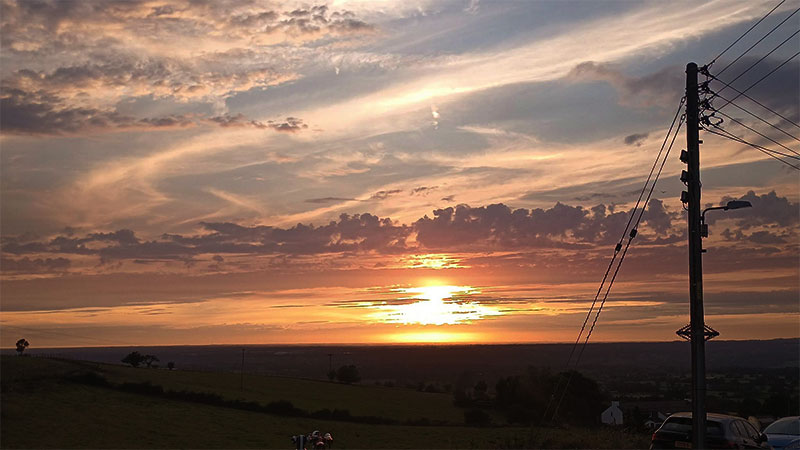
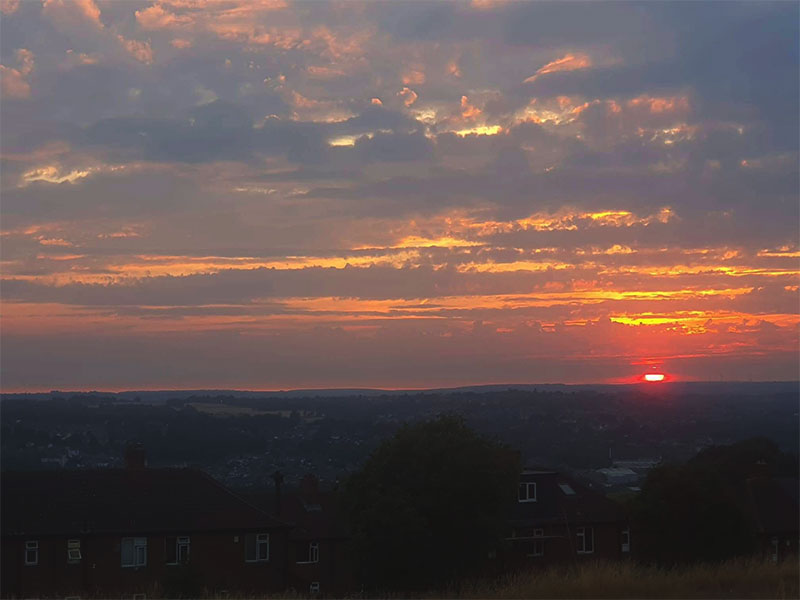
For photographers, the low Sun also created opportunities to capture the eclipsed Sun alongside landscapes, buildings and skylines.
Did the UK Experience Totality?
No.
The UK was outside the path of totality.
The global eclipse was a total solar eclipse, but totality was visible in parts of Greenland, Iceland and northern Spain, rather than Britain.
People in the UK therefore saw a partial eclipse, even though the coverage was very high.
This distinction is important. A 90% or 95% partial eclipse is impressive, but it is not the same astronomical experience as totality.
What Did Eclipse 2026 Look Like Across Britain?
At maximum eclipse, most of the Sun’s visible disc was covered in many parts of Britain.
In London, approximately 91% was obscured, while some locations in south-western Britain saw around 95%.
Despite the high coverage, the UK did not become completely dark.
The Royal Observatory Greenwich noted that the light level could change noticeably and feel more like a cloudy day or the period around dusk, but total darkness did not occur.
How to Read an Eclipse 2026 Map
An eclipse map can look complicated at first, but the basic idea is simple.
The different areas on the map indicate:
Where the eclipse was visible:
Areas inside the partial-eclipse region could see part of the Sun covered.
How much of the Sun was covered:
Different map shading indicates different levels of obscuration.
Path of totality:
This is where the Moon completely covered the Sun. It did not cross the UK during the August 2026 event.
Local timing:
The precise start, maximum and end times depend on the observer’s location.
Eclipse 2026 UK Map: Best Locations to Compare
For anyone researching the event, comparing a few locations can give a good sense of how the eclipse varied geographically.
London: around 91% coverage.
Bristol: around 93%.
Cardiff: around 93%.
Southampton: around 93%.
Cornwall: roughly 95%.
The general pattern was clear: moving towards the south-west increased the amount of the Sun covered.
Solar Eclipse Safety
A map tells you where an eclipse is visible, but it does not make direct solar viewing safe.
Never look directly at the Sun without appropriate solar eye protection.
Ordinary sunglasses are not designed for eclipse viewing. Looking through an unfiltered telescope, binoculars or camera optical equipment can cause severe and permanent eye damage.
For future solar eclipses, use suitable certified solar viewing equipment and follow the manufacturer’s instructions.
Eclipse 2026 UK Map: Frequently Asked Questions
Was Eclipse 2026 visible across the UK?
Yes. The 12 August 2026 eclipse was visible as a partial solar eclipse across England, Scotland, Wales and Northern Ireland.
Which part of the UK had the greatest eclipse coverage?
The south-western UK generally experienced the greatest coverage, with Cornwall reaching roughly 95%.
How much of the Sun was covered in London?
Around 90–91%, depending on the source’s rounding and calculation method. Timeanddate gives 91.38%, while the Royal Observatory Greenwich rounds this to about 90%.
Was there a total solar eclipse in the UK?
No. Totality was not visible from the UK.
What time did the eclipse start in the UK?
The exact start time depended on location. Timeanddate lists a UK-wide partial-eclipse start as early as 5:59pm BST, with England beginning around 6:09pm and Wales around 6:13pm.
Why did eclipse timings vary between UK cities?
Different locations on Earth view the Moon and Sun from slightly different angles, so the start, maximum and end of the eclipse occurred at different local times.
The Eclipse 2026 Map: UK Visibility Guide shows just how much location mattered during the 12 August 2026 solar eclipse.
The eclipse was visible across the United Kingdom as a partial solar eclipse, but the amount of the Sun covered varied from place to place. The south-west generally experienced the greatest coverage, with Cornwall reaching roughly 95%, while London saw around 90–91%.
The event was also unusual because the eclipse took place close to sunset. That made a clear western horizon almost as important as the percentage of coverage shown on the map.
Although the UK did not experience totality, the 2026 eclipse was one of the most impressive solar eclipses visible from Britain in many years. The Royal Observatory Greenwich described it as the highest level of eclipse coverage seen from the UK and Ireland since 1999.
For anyone studying Eclipse 2026 UK visibility, the map tells an important story: the experience was not exactly the same everywhere, and your location determined how much of the Sun disappeared behind the Moon.
Eclipse 2026 UK: Date, Time, Map, Visibility & What Happened
More Eclipse & Astronomy Guides
- Eclipse 2026 UK: Everything You Need to Know
- Eclipse 2026 UK Time: Exact Timings by Location
- Eclipse 2026 London: Where and When to Watch
- Eclipse 2026 Map: UK Visibility Guide
- Solar Eclipse 2026: What Will You See?
- How to Watch Eclipse 2026 Safely: Eye Protection Guide
- Eclipse 2026 Weather: What UK Viewers Should Know
- Best Places to Watch Eclipse 2026 in the UK
- Eclipse 2026 Photography Guide: How to Photograph a Solar Eclipse
- What Is the Next Solar Eclipse After 2026? UK Dates & Times
Suggested
- Royal Observatory Greenwich
- Timeanddate Eclipse Information
- https://www.nasa.gov/
- European solar eclipses
- 2026 Total Solar Eclipse
editor – joge cruch